Sustainability
Every pallet we recycle is a vote for the planet. Discover how our circular economy model diverts millions of pallets from landfills, conserves forests, and reduces carbon emissions.
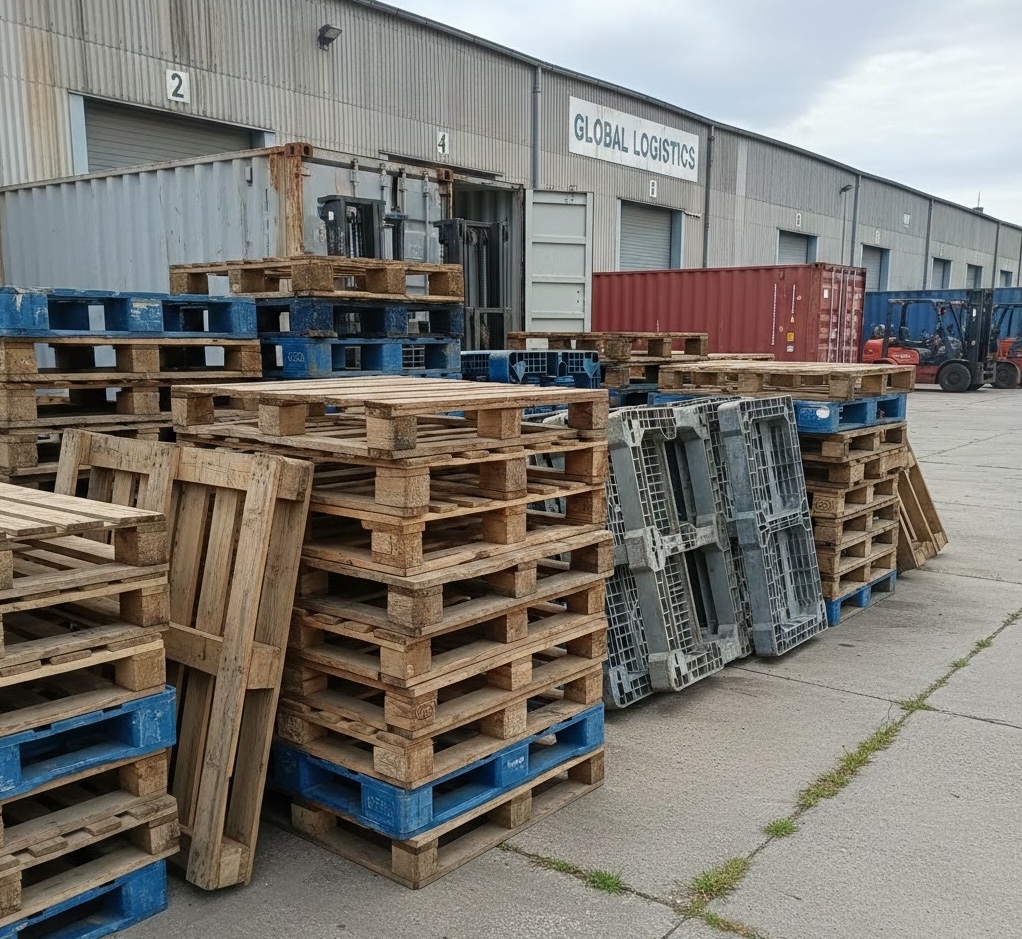
Green Operations, Real Impact
2.4 million pallets recycled annually — 4,800 tons diverted from landfills
Go Green Today
Switch to recycled pallets and reduce your company's environmental footprint. Get a free quote now.
The Environmental Cost of Pallet Waste
The pallet industry is one of the largest consumers of lumber in the United States. Without intervention, the waste is staggering.
Why This Matters
When a wooden pallet ends up in a landfill, it does not simply disappear. As it decomposes, it releases methane — a greenhouse gas 80 times more potent than CO2 in the short term. The nails, staples, and chemical treatments in some pallets can leach into soil and groundwater, creating long-term environmental contamination.
Manufacturing new pallets to replace those discarded requires harvesting additional timber, consuming energy for sawmill operations, and burning fuel for transportation. The entire chain generates significant carbon emissions that could be avoided through reuse and recycling.
The solution is not complicated — it simply requires a commitment to keeping pallets in the supply chain as long as possible. That is exactly what we do.
Deforestation
Manufacturing 1 new pallet requires approximately 12-15 board feet of hardwood lumber. Reusing pallets directly reduces the demand for virgin timber.
Carbon Emissions
Producing a new standard pallet generates roughly 28.5 kg of CO2. Recycling an existing pallet uses 85% less energy and produces a fraction of those emissions.
Landfill Contamination
Treated wood in landfills can leach chemicals into soil and waterways. Our zero-waste process ensures no pallet material ever reaches a landfill.
The Circular Economy of Pallets
In a circular economy, materials are kept in use for as long as possible, extracting maximum value before recovery and regeneration. Here is how our model works.
Collection
We pick up used pallets from warehouses, retailers, and manufacturers across the country.
Sorting & Inspection
Every pallet is inspected, graded, and sorted by condition: reusable, repairable, or recyclable.
Repair & Refurbishment
Pallets that need minor fixes get new boards, reinforced joints, and fresh nails from skilled technicians.
Resale & Distribution
Quality-tested pallets are sold to businesses at up to 50% less than new pallet prices.
Material Recovery
Pallets beyond repair are dismantled. Usable boards go to repair stock; the rest is processed for secondary use.
Recycling & Upcycling
Remaining wood is converted into mulch, animal bedding, biomass fuel, or raw material for particle board.
Zero Waste, Zero Exceptions
In our circular model, nothing goes to waste. A pallet might cycle through our system multiple times — sold, used, returned, repaired, and sold again. When it finally reaches end of life, 100% of its material is recovered and repurposed. No wood, no nails, no material of any kind leaves our facilities destined for a landfill.
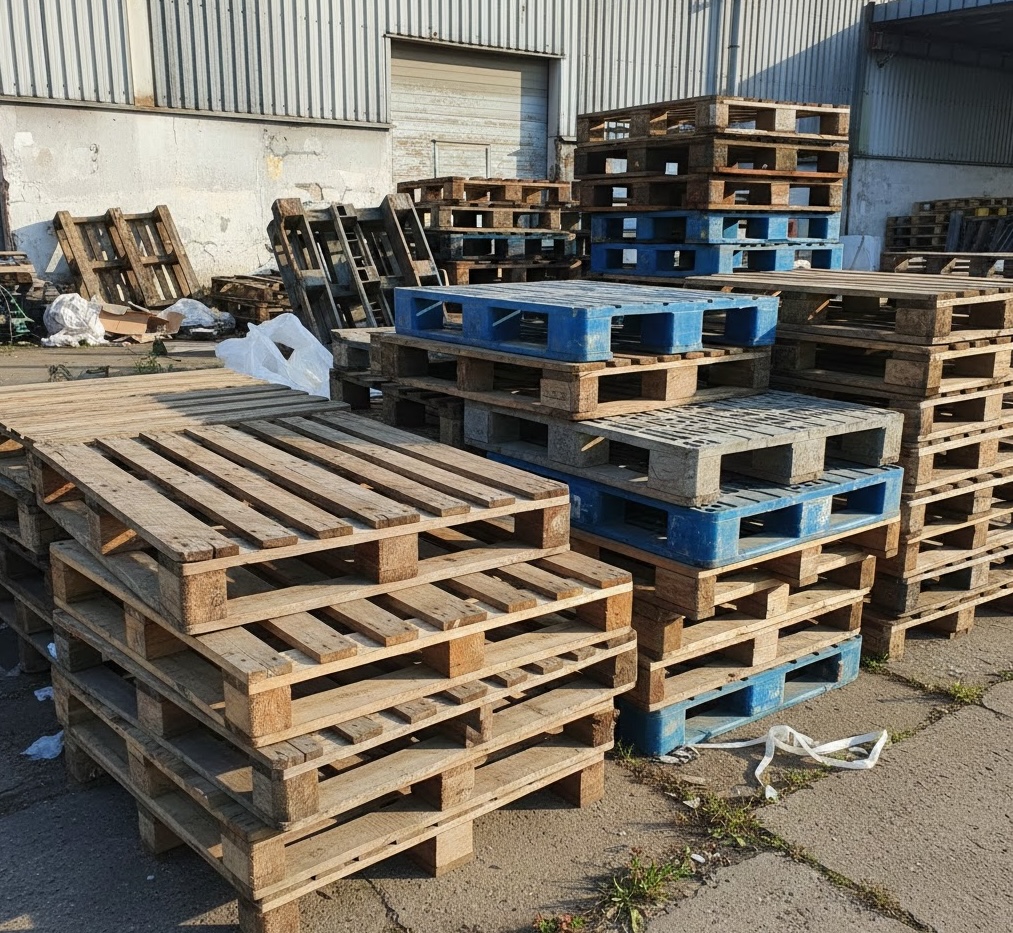
Closing the Loop
Our recycling process recovers over 95% of pallet materials. Wood is repaired, reused, or converted into mulch and biomass fuel. Metal fasteners are separated and recycled. Even damaged boards find new life as landscape material. Nothing goes to waste.
Reducing Our Carbon Footprint
Every used pallet we keep in circulation prevents the carbon emissions that would be generated by manufacturing a replacement. The numbers are significant.
Our Path to Carbon Neutrality
Began replacing diesel trucks with hybrid vehicles. 30% of fleet now hybrid or electric.
In ProgressInstalling solar panels at all 8 facilities, targeting 40% of energy needs from solar.
In ProgressComplete transition to electric and hybrid delivery vehicles across all locations.
PlannedAchieve full carbon neutrality through renewables, efficiency, and verified offsets.
TargetKeeping Pallets Out of Landfills
Our Landfill Diversion Program is the cornerstone of our sustainability efforts. We work with businesses of all sizes to ensure that their used, surplus, and damaged pallets are collected, processed, and recirculated rather than discarded.
Free Pickup Service
We pick up used pallets from your location at no cost. No minimums, no contracts required. Simply call, and we will schedule a pickup that works for your operations.
Every Pallet Gets a Plan
Nothing is thrown away. Pallets in good condition are resold. Damaged pallets are repaired. End-of-life pallets are dismantled and their materials recycled into mulch, bedding, or biomass fuel.
Diversion Reporting
We provide our partners with detailed reports showing exactly how many pallets were diverted from landfill, the weight of materials recovered, and the estimated environmental impact.
Certified Zero Waste
Our facilities maintain zero-waste-to-landfill certification. 100% of all pallet materials that enter our locations are reused, recycled, or repurposed — guaranteed.
Diversion by the Numbers
Protecting America's Forests
Pallet manufacturing is one of the largest single uses of hardwood lumber in the United States. By recycling and reusing pallets, we directly reduce the demand for virgin timber and help preserve forests.
The Tree-to-Pallet Connection
A single standard 48x40 wooden pallet requires approximately 12-15 board feet of hardwood lumber to manufacture. A typical hardwood tree yields about 40-50 board feet of usable lumber. That means roughly 3 new pallets require the equivalent of one tree.
When you consider that hundreds of millions of pallets are manufactured each year, the impact on forests is enormous. By extending the life of existing pallets through repair and reuse, we significantly reduce the volume of new lumber needed.
But we do not stop at conservation. Through our partnership with the National Forest Foundation, we actively fund reforestation projects. For every 100 pallets we recycle, we plant at least one new tree, contributing to forest restoration in areas impacted by wildfire, disease, and over-harvesting.
Our Reforestation Partners
National Forest Foundation
Our primary reforestation partner since 2017. Together, we have planted over 50,000 trees in national forests across Colorado, Montana, California, and Oregon.
One Tree Planted
We contribute to global reforestation efforts through One Tree Planted, supporting projects in both North American and tropical forests.
Arbor Day Foundation
We sponsor community tree planting events through the Arbor Day Foundation in the cities where our facilities operate.
Local Conservation Districts
We work with local soil and water conservation districts to support native tree planting and riparian habitat restoration near our warehouses.
How Pallet Recycling Works
A step-by-step look at how we transform used pallets into valuable products while ensuring nothing goes to waste.
Collection & Pickup
Our trucks collect used pallets from warehouses, distribution centers, manufacturers, and retailers. We offer scheduled regular pickups or on-demand service based on your needs. Pallets are carefully loaded and transported to our nearest processing facility.
We currently operate over 30 collection routes across the continental U.S., and our logistics team optimizes every route to minimize fuel consumption and maximize the number of pallets collected per trip.
Receiving & Initial Sorting
At our facility, incoming pallets are unloaded and sorted into three initial categories: reusable as-is, repairable, and recyclable. This first sort is performed by experienced inspectors who can assess a pallet's condition in seconds.
Our initial sort accuracy exceeds 95%. Pallets that are clearly in excellent condition are fast-tracked for cleaning and grading, while those needing attention move to the repair line.
Detailed Inspection & Grading
Pallets flagged as reusable undergo a multi-point inspection. We check board integrity, stringer condition, nail placement, overall dimensions, and load-bearing capacity. Each pallet is assigned a grade: A (Like New), B (Good), or C (Economy).
Our grading system follows industry standards established by the National Wooden Pallet and Container Association (NWPCA). Every grade has defined criteria for board condition, structural integrity, and cosmetic appearance.
Repair & Refurbishment
Pallets that need repair are sent to our repair stations, staffed by skilled technicians. Common repairs include replacing broken deck boards, reinforcing stringers, removing protruding nails, and adding new fasteners. Repaired pallets are re-inspected before being approved for sale.
Our repair teams process an average of 500 pallets per day per facility. We source replacement boards from dismantled pallets whenever possible, keeping our repair process circular and minimizing the need for new lumber.
Dismantling & Material Recovery
Pallets that cannot be economically repaired are carefully dismantled. Usable boards are extracted and added to our repair stock. Nails and metal hardware are separated for metal recycling. The remaining wood is processed for secondary applications.
We recover usable boards from approximately 60% of dismantled pallets, giving those boards a second life in repaired pallets. Metal hardware recovery rates exceed 98%.
Wood Processing & Recycling
Wood that cannot be reused in pallets is ground through industrial chippers and processed into value-added products: landscaping mulch, animal bedding, playground surfacing material, and biomass fuel pellets for industrial energy generation.
We produce over 5,000 cubic yards of premium mulch and 2,000 tons of biomass fuel annually from recycled pallet wood. These products displace virgin materials and fossil fuels, creating additional environmental benefits.
Quality Control & Distribution
Finished pallets — whether resold as-is, repaired, or newly graded — pass a final quality check before being stacked, stored, and prepared for delivery. Our distribution team coordinates delivery schedules to get pallets to customers efficiently.
We maintain an inventory of over 200,000 pallets across all facilities at any given time, ensuring availability and fast fulfillment for orders of any size.
Certified Sustainable
Our environmental commitments are backed by recognized certifications and third-party verification.
ISPM-15 Certified
International Plant Protection Convention
Our heat treatment facilities are certified under ISPM-15 for international phytosanitary compliance. All treated pallets are stamped and documented for export use.
SFI Certified
Sustainable Forestry Initiative
We maintain chain-of-custody certification under the Sustainable Forestry Initiative, ensuring that any new wood entering our supply chain comes from responsibly managed forests.
Zero Waste Certified
TRUE Zero Waste Certification
Our processing facilities hold TRUE Zero Waste certification, verifying that we divert at least 90% (and in practice, 100%) of all waste from landfills and incineration.
NWPCA Member
National Wooden Pallet & Container Association
As members of the NWPCA, we adhere to industry best practices for pallet grading, repair, and safety, and participate in ongoing research to advance sustainable pallet management.
EPA SmartWay Partner
U.S. Environmental Protection Agency
We participate in the EPA SmartWay program, which recognizes companies committed to reducing transportation-related emissions through fuel efficiency and route optimization.
ISO 14001 Aligned
Environmental Management System
Our environmental management practices are aligned with ISO 14001 standards, providing a systematic framework for measuring and improving our environmental performance.
Environmental Commitments
We hold ourselves accountable with public, measurable environmental goals. Here is where we stand and where we are headed.
5 Million Pallets Diverted Annually by 2030
2M+ currentlyWe are investing in new facilities, expanded collection routes, and technology to more than double our annual pallet diversion rate within the next five years.
Carbon Neutral Operations by 2027
45% reduction achievedThrough fleet electrification, solar energy installation, efficiency improvements, and verified carbon offsets, we will eliminate our net carbon emissions.
100,000 Trees Planted by 2030
50,000+ plantedAccelerating our reforestation partnerships to reach 100,000 trees planted, restoring forests impacted by wildfire, disease, and over-harvesting.
100% Renewable Energy by 2028
25% renewable currentlySolar panel installations at all facilities combined with renewable energy purchasing agreements to power all operations with clean energy.
50% Water Reduction by 2028
20% reduction achievedImplementing water recycling systems, rainwater harvesting, and low-water cleaning processes to reduce freshwater consumption at all facilities.
Zero Single-Use Plastics by 2026
80% eliminatedRemoving all single-use plastics from our operations, packaging, and offices, replacing them with reusable or compostable alternatives.
What Choosing Used Means
Every business that switches to recycled pallets makes a measurable difference. Here is what different volumes of used pallet purchases can achieve.
Working Together for a Greener Future
We partner with leading environmental organizations to amplify our impact beyond what we can achieve alone.
National Forest Foundation
Reforestation PartnerOur flagship partnership since 2017. We fund tree planting in national forests across the western United States, focusing on areas impacted by wildfire and beetle infestations. To date, this partnership has resulted in over 50,000 trees planted across Colorado, Montana, California, and Oregon.
One Tree Planted
Global ReforestationWe contribute to international reforestation through One Tree Planted, supporting projects in the Amazon, Southeast Asia, and sub-Saharan Africa. This broadens our environmental impact beyond domestic borders and supports biodiversity in tropical ecosystems.
Arbor Day Foundation
Community Tree PlantingThrough the Arbor Day Foundation, we sponsor community tree planting events in the cities where our facilities are located. These events engage our employees and local residents in hands-on conservation, creating green spaces in urban and suburban areas.
EPA SmartWay Program
Transportation EfficiencyAs a SmartWay partner, we commit to measuring, benchmarking, and improving the fuel efficiency of our transportation operations. We share best practices with other logistics companies to drive industry-wide emissions reductions.
National Wooden Pallet & Container Association
Industry Standards & AdvocacyOur NWPCA membership connects us with industry peers working on sustainable pallet management. We participate in committees focused on recycling best practices, safety standards, and environmental policy advocacy.
Local Food Banks
Community SupportWe donate refurbished pallets to food banks across our service areas, helping them manage and distribute food donations more efficiently. Last year, we donated over 5,000 pallets to food assistance organizations.
Calculate Your Pallet Carbon Savings
Switching from new pallets to recycled pallets has a measurable impact on your company's carbon footprint. Here is how to calculate the environmental savings for your business.
How the Calculation Works
Count Your Annual Pallet Usage
Determine how many pallets your business purchases or uses per year. Include one-way and returnable pallets across all facilities.
Apply the Carbon Factor
Each new standard pallet generates approximately 28.5 kg of CO2 during manufacturing. Each recycled pallet generates only 4.3 kg. The difference — 24.2 kg — is your per-pallet savings.
Multiply for Total Savings
Multiply your annual pallet volume by 24.2 kg to find your total CO2 savings in kilograms. Divide by 1,000 to convert to metric tons.
Add Landfill Diversion Impact
Each pallet diverted from landfill prevents approximately 3.6 kg of methane from decomposition over its landfill lifespan. Factor this into your total greenhouse gas reduction.
Quick Reference: CO2 Savings by Volume
Want a Custom Impact Report?
Contact our sustainability team and we will prepare a detailed environmental impact analysis tailored to your pallet volume, industry, and reporting requirements. We provide data compatible with GRI, CDP, and SASB sustainability reporting frameworks.
Request Custom ReportWood Waste Diversion by Year
Tracking our progress year by year. Every ton of wood diverted from landfill represents real environmental impact.
| Year | Pallets Diverted | Tons of Wood Saved | CO2 Prevented (Tons) | Trees Saved (Equiv.) |
|---|---|---|---|---|
| 2019 | 1,500,000 | 3,000 | 8,500 | 18,750 |
| 2020 | 1,650,000 | 3,300 | 9,350 | 20,625 |
| 2021 | 1,800,000 | 3,600 | 10,200 | 22,500 |
| 2022 | 1,950,000 | 3,900 | 11,050 | 24,375 |
| 2023 | 2,000,000 | 4,000 | 11,700 | 25,000 |
| 2024 | 2,150,000 | 4,300 | 12,500 | 26,875 |
| 2025 (proj.) | 2,400,000 | 4,800 | 15,000 | 30,000 |
Sustainability Impact Reports for Clients
We help our customers measure, report, and communicate the environmental impact of their pallet operations. Our reporting tools integrate seamlessly with corporate sustainability disclosures.
Quarterly Environmental Impact Reports
Every partner receives a detailed quarterly report showing pallets diverted from landfill, equivalent trees saved, CO2 emissions prevented, and wood waste recycled. Reports include charts and data tables ready for board presentations.
ESG-Ready Data Packages
Our sustainability data is formatted for compatibility with GRI (Global Reporting Initiative), CDP (Carbon Disclosure Project), and SASB (Sustainability Accounting Standards Board) frameworks. Your ESG team can plug our numbers directly into their disclosures.
Custom Sustainability Dashboards
Gold and Platinum partners get access to real-time sustainability dashboards showing their environmental impact metrics updated daily. Track your green progress alongside order volume, cost savings, and service quality metrics.
Annual Sustainability Certificates
We issue annual certificates quantifying each partner's contribution to our circular economy model. These certificates document total pallets recycled, carbon avoided, and landfill waste diverted for the calendar year.
Scope 3 Emissions Documentation
For companies tracking Scope 3 (supply chain) emissions, we provide detailed carbon accounting for pallet-related activities including transportation, processing, and end-of-life management across your entire pallet lifecycle.
Marketing Impact Materials
We provide co-branded infographics, data sheets, and social media content that partners can use to communicate their sustainability achievements to customers, investors, and the public.
Accountability Matters
2024 Sustainability Snapshot
We publish annual sustainability reports to hold ourselves accountable and keep our partners informed. Here are the highlights from our most recent report.
Make Your Supply Chain Greener Today
Every pallet you buy, sell, or recycle with Pallets Resale is a direct contribution to reducing waste, conserving forests, and lowering carbon emissions. The switch is easy.