Pallet Size Guide
Your comprehensive reference for standard pallet dimensions, load capacities, and industry specifications. Find the perfect pallet for your application.
Pallet Size Guide
Find the right pallet dimensions for your application
Need Help Choosing? Ask Us
Not sure which size is right for your application? Our pallet experts are here to help.
Standard Pallet Dimensions
Below is a comprehensive table of the most widely used pallet sizes in North America and internationally, including dimensions in both imperial and metric units.
| Pallet Name | Dimensions (in) | Dimensions (cm) | Weight (lbs) | Load Capacity (lbs) | Standard | Common Uses |
|---|---|---|---|---|---|---|
| 48" x 40" (GMA) | 48" x 40" | 121.9 x 101.6 | 33-48 | 2,500-4,600 | GMA / NWPCA | Grocery, retail, general warehousing. The most common pallet in North America. |
| 42" x 42" | 42" x 42" | 106.7 x 106.7 | 35-45 | 2,500-3,500 | ISO | Telecommunications, paint, and drum industries. |
| 48" x 48" | 48" x 48" | 121.9 x 121.9 | 40-55 | 3,500-5,000 | ISO | Drums, barrels, and square-footprint cargo. Popular in chemical industry. |
| 48" x 45" | 48" x 45" | 121.9 x 114.3 | 35-50 | 2,800-4,500 | Automotive | Automotive industry standard. Also used in chemical shipping. |
| 36" x 36" | 36" x 36" | 91.4 x 91.4 | 25-35 | 2,000-3,000 | Beverage | Beverage industry, small-footprint loads, and point-of-purchase displays. |
| 48" x 20" | 48" x 20" | 121.9 x 50.8 | 18-25 | 1,500-2,500 | Retail | Retail displays, half-pallets for store aisles and promotional setups. |
| 44" x 44" | 44" x 44" | 111.8 x 111.8 | 35-50 | 2,800-4,000 | Chemical | Chemical and drum industries. Fits 55-gallon drums efficiently. |
| 48" x 36" | 48" x 36" | 121.9 x 91.4 | 30-42 | 2,500-3,800 | Beverage / Paper | Beverage, shingles, and packaged paper industries. |
| 40" x 40" | 40" x 40" | 101.6 x 101.6 | 30-40 | 2,500-3,500 | Dairy | Dairy industry and square-footprint cargo. |
| 48" x 42" | 48" x 42" | 121.9 x 106.7 | 35-48 | 2,500-4,200 | Chemical / Paint | Paint cans, chemical containers, and general industrial use. |
| 40" x 48" (Turned GMA) | 40" x 48" | 101.6 x 121.9 | 33-48 | 2,500-4,600 | GMA | Same as GMA but oriented differently for specific racking configurations. |
| 800 x 1200 mm (EPAL/EUR) | 47.2" x 31.5" | 120 x 80 | 55 (25 kg) | 3,300 (1,500 kg) | EPAL / EUR | European standard pallet. Used globally for international shipping. |
| 1000 x 1200 mm (EUR2) | 39.4" x 47.2" | 100 x 120 | 72 (33 kg) | 3,300 (1,500 kg) | EPAL / EUR | European industrial pallet. Common in UK and continental Europe. |
| 1067 x 1067 mm (AUS) | 42" x 42" | 106.7 x 106.7 | 40-50 | 4,400 (2,000 kg) | ISO / Australian | Australian standard. Also used in parts of Asia-Pacific region. |
* Weights and load capacities are approximate and vary based on wood species, moisture content, and construction method.
GMA Pallet Standard (48" x 40")
The Grocery Manufacturers Association (GMA) pallet is the most widely used pallet in North America, accounting for approximately 30% of all new wood pallets produced annually. The standard 48" x 40" footprint is optimized for standard trailer widths (102 inches) and warehouse racking systems.
- Two pallets fit side by side in a standard 53-foot trailer
- Compatible with all major retailer requirements
- Managed by the NWPCA (National Wooden Pallet & Container Association)
- Available in stringer and block designs
EPAL / EUR Pallet Standard (800 x 1200 mm)
The European Pallet Association (EPAL) manages the EUR pallet, which is the dominant standard across Europe. With over 600 million EPAL pallets in circulation, this is one of the world's largest pallet pooling systems. EPAL pallets are built to strict specifications and each one is individually branded.
- Exchangeable across all EPAL member countries
- ISPM-15 heat treated for international shipping
- Block pallet design with four-way entry
- 78 nails per pallet with strict nail pattern specifications
Understanding Pallet Construction
Knowing the parts of a pallet helps you communicate your needs more effectively and understand quality differences between grades.
Top Deck Boards
The horizontal boards on the top surface where goods are placed. Typically 5 to 7 boards per pallet. Board width and spacing affect load distribution and product stability. Closer spacing provides better support for smaller items.
Bottom Deck Boards
Horizontal boards on the underside of the pallet that provide stability and allow forklift entry from multiple sides. Block pallets typically have 3 bottom deck boards; stringer pallets may have 3 to 5.
Stringers
Long boards (usually 2x4 or 3x4 lumber) running the length of the pallet between the top and bottom decks. Stringer pallets typically have 3 stringers. Notched stringers allow partial four-way forklift entry.
Blocks
Solid wood blocks (typically 6 or 9 per pallet) used in block-style pallets instead of stringers. Blocks provide true four-way forklift entry and are generally stronger. EPAL pallets always use block construction.
Lead Boards
The outermost deck boards on the top and bottom surfaces. These boards are critical structural elements and are often wider than inner deck boards to provide better edge support and prevent damage during handling.
Notches
Cutouts in the stringers of stringer-style pallets that allow forklift tines to enter from the sides (the 40-inch direction on a GMA pallet). Without notches, stringer pallets would only allow two-way entry.
Chamfered Edges
Beveled or rounded edges on the bottom lead boards that help guide forklift tines into the pallet openings. Chamfered edges reduce damage during handling and make the pallet easier to pick up.
Deck Mat / Deckboard Spacing
The gap between top deck boards. Standard spacing is typically 2.5 to 3 inches for GMA pallets. Tighter spacing (or full-deck/close-boarded designs) is available for small items or automated conveyor systems.
Stringer Boards (Cross Members)
In block pallets, horizontal boards running between the blocks that connect them and support the deck boards. These are different from stringers in stringer pallets and provide additional structural integrity.
How to Choose the Right Size
Consider Your Product Dimensions
The pallet should match or slightly exceed your product footprint. Products should not overhang more than 1 inch on any side to prevent damage during transportation and ensure safe stacking.
Check Weight Requirements
Calculate the total weight of your loaded pallet including the pallet itself. Ensure the pallet's rated load capacity exceeds your requirements by at least 20% for a safety margin. Dynamic load ratings (when in motion) are typically lower than static ratings.
Match Your Racking System
Verify that the pallet dimensions are compatible with your warehouse racking. Standard pallet racking is designed for 48" x 40" pallets. Non-standard sizes may require custom racking or adjustments.
Think About Transportation
Two 48" x 40" pallets fit perfectly side-by-side in a standard 53-foot trailer. Using non-standard sizes may result in wasted trailer space and higher shipping costs per unit.
Review Industry Requirements
Many industries and retailers have specific pallet requirements. Check with your customers or trading partners before ordering. International shipping often requires ISPM-15 heat-treated pallets.
Quick Selection Summary
Not Sure Which Size?
Our pallet experts can help you choose the right size and grade for your specific application. Whether you need standard GMA 48×40 pallets or custom dimensions, we have the inventory and expertise to match your requirements.
How to Measure Your Pallet
Accurate measurements are essential when ordering replacement pallets or specifying custom sizes. Follow these steps to measure your pallets correctly every time.
Measure the Length (Stringer Direction)
Place your tape measure along the longest side of the pallet, running parallel to the stringers or stringer boards. This is always the first number in a pallet dimension. For a GMA pallet, the length is 48 inches. Measure from the outside edge of one lead board to the outside edge of the opposite lead board.
Measure the Width (Deck Board Direction)
Measure across the deck boards, perpendicular to the stringers. This is the second number in the dimension. For a GMA pallet, the width is 40 inches. Again, measure from the outer edge of one side to the outer edge of the opposite side.
Measure the Height
Measure from the bottom of the lower deck boards to the top surface of the upper deck boards. Standard pallet height is approximately 6 inches for stringer pallets and 6.5 inches for block pallets. Height is important for automated handling systems and racking clearance calculations.
Note the Entry Type
Determine whether the pallet has two-way or four-way forklift entry. Two-way entry means forks can only enter from two sides (the open stringer sides). Four-way entry allows forks from all four sides, either through notched stringers or block construction.
Count the Deck Boards
Record the number of top and bottom deck boards, as well as the approximate width of each board and the spacing between them. This information is essential for matching replacement pallets to your existing inventory or racking system.
Measurement Tips
Custom Size Ordering Process
Need a size that is not on the standard list? Our custom pallet program can produce virtually any dimension, construction style, or material specification your application requires.
Submit Requirements
Contact us with your desired dimensions, load capacity needs, material preferences, and quantity. Include details about your application so we can recommend the optimal construction method.
Engineering Review
Our pallet engineers review your specifications using the Pallet Design System (PDS) software. We optimize board thickness, spacing, and fastener patterns to ensure your custom pallet meets performance requirements at the best possible cost.
Sample & Approval
For large orders, we produce a sample pallet for your review and testing. You can verify dimensions, load performance, and compatibility with your equipment before we begin full production.
Production & Delivery
Once approved, we manufacture your custom pallets to specification. Standard lead times are 5 to 10 business days depending on quantity and complexity. Rush orders are available for time-sensitive needs.
Pallet Sizes by Industry
Different industries have standardized on specific pallet sizes to optimize their supply chains. Here is a breakdown of the most common pallet dimensions used across major sectors.
Grocery & Retail
Recommended: 48" x 40" GMA
The industry standard for consumer packaged goods. Required by most major retailers including Walmart, Kroger, and Costco. Optimized for standard 53-foot trailers and warehouse racking systems. Stringer or block construction.
Automotive
Recommended: 48" x 45"
Widely adopted across the automotive supply chain. The additional 5 inches of width compared to GMA pallets accommodates larger automotive parts and components. Used by major manufacturers including Ford, GM, and Toyota.
Chemical & Pharmaceutical
Recommended: 48" x 48" or 44" x 44"
Square pallets are preferred for drum storage, as they efficiently accommodate 55-gallon drums and large containers. The symmetrical footprint prevents overhang and simplifies stacking in chemical storage facilities.
Beverage
Recommended: 36" x 36" or 48" x 36"
Beverage companies often use smaller pallets to manage the heavy weight of liquid products. The 36x36 format is ideal for point-of-purchase displays, while the 48x36 is standard for warehouse distribution of cases and kegs.
Telecommunications
Recommended: 42" x 42"
An ISO standard size adopted by the telecom industry for shipping equipment, cable reels, and hardware. The square format works well with the boxy dimensions of telecom equipment and server racks.
Food & Dairy
Recommended: 40" x 40"
The dairy industry standardized on this size for its compatibility with cooler dimensions and processing equipment. Also used in some food manufacturing applications where the slightly smaller footprint is advantageous for cold storage layouts.
Retail Displays & POP
Recommended: 48" x 20" Half Pallet
Half pallets are designed for in-store displays and point-of-purchase setups. They fit in standard retail aisles and can be placed directly on the sales floor. Popular with consumer electronics, seasonal merchandise, and promotional items.
European Export
Recommended: 800 x 1200 mm EPAL
Mandatory for most European supply chains. The EPAL pallet is exchangeable across all EU member states, eliminating the need for pallet returns. Required for shipments to major European retailers and distributors.
Paint & Coatings
Recommended: 48" x 42"
Used extensively in the paint and coatings industry for shipping cans and buckets. The dimensions optimize packing patterns for standard gallon and five-gallon containers, minimizing wasted space during transport.
International Pallet Size Standards
The International Organization for Standardization (ISO) recognizes six pallet dimensions for global trade. Understanding these standards is essential for businesses involved in international shipping and cross-border supply chains.
| ISO Standard | Dimensions (mm) | Dimensions (in) | Primary Region | Common Name |
|---|---|---|---|---|
| ISO 1 | 1219 x 1016 | 48" x 40" | North America | GMA Pallet |
| ISO 2 | 1000 x 1200 | 39.4" x 47.2" | Europe, Asia | EUR 2 / UK Pallet |
| ISO 3 / EUR 1 | 800 x 1200 | 31.5" x 47.2" | Europe | EPAL / EUR Pallet |
| ISO 4 | 1067 x 1067 | 42" x 42" | Australia, N. America | Australian Standard |
| ISO 5 | 1100 x 1100 | 43.3" x 43.3" | Asia Pacific | AS Pallet / T11 |
| ISO 6 | 1140 x 1140 | 44.9" x 44.9" | Australia | Australian Alternate |
European Pallets (EUR / EPAL)
The EPAL system includes multiple standardized sizes beyond the well-known EUR 1. The EUR 2 (1200 x 1000 mm) is used heavily in industrial and automotive applications, while the EUR 6 (800 x 600 mm) serves as a half-pallet for retail displays. All EPAL pallets feature block construction with nine blocks and true four-way forklift entry.
Asia-Pacific Pallets
The most common pallet in the Asia-Pacific region is the T11 pallet (1100 x 1100 mm), which is the standard in Japan, South Korea, and parts of Southeast Asia. Australia uses the 1067 x 1067 mm (42 x 42 inch) pallet, which is also recognized as an ISO standard. China has been gradually adopting the 1100 x 1100 mm standard but also uses 1200 x 1000 mm pallets extensively.
Shipping Considerations
When shipping internationally, pallet size selection affects container utilization, freight costs, and compliance requirements. Here are key factors to consider for cross-border shipments.
- 20-foot containers fit EUR 1 pallets: 11 pallets per layer
- 40-foot containers fit 20-24 GMA pallets depending on orientation
- ISPM-15 treatment required for all raw wood pallets in international trade
- Some countries require additional fumigation certificates
- Pallet height limits vary by shipping line and container type
- Consider using plastic or metal pallets to avoid phytosanitary requirements
Weight Capacity by Size
Understanding the difference between static, dynamic, and racking load capacities is critical for safe pallet use. Below are approximate load ratings for the most common pallet sizes in good condition (Grade A or B).
| Pallet Size | Static Load (lbs) | Dynamic Load (lbs) | Racking Load (lbs) | Notes |
|---|---|---|---|---|
| 48" x 40" (GMA) | 4,600 | 2,500 | 2,800 | Most tested and documented pallet size |
| 42" x 42" | 3,500 | 2,200 | 2,000 | Square design distributes loads evenly |
| 48" x 48" | 5,000 | 3,000 | 2,500 | Heavy-duty construction common |
| 48" x 45" | 4,500 | 2,800 | 2,400 | Automotive spec often exceeds minimums |
| 36" x 36" | 3,000 | 2,000 | 1,800 | Smaller span increases relative strength |
| 48" x 20" | 2,500 | 1,500 | 1,200 | Half-pallet, limited racking use |
| 44" x 44" | 4,000 | 2,500 | 2,200 | Chemical industry heavy-duty spec |
| 40" x 40" | 3,500 | 2,200 | 2,000 | Dairy industry standard construction |
| 800 x 1200 mm (EUR) | 4,400 | 2,800 | 2,200 | EPAL block construction, strictly controlled |
Understanding Load Capacity Types
Static Load
The maximum weight a pallet can support when resting on a flat, level surface without being moved. This is the highest capacity rating because the load is evenly distributed and there are no dynamic forces. Use this rating for long-term storage on warehouse floors.
Dynamic Load
The maximum weight during lifting and transport by forklift or pallet jack. Dynamic loads impose additional stress from acceleration, deceleration, and uneven surfaces. This rating is typically 40-55% of the static load. Always use this rating for materials being actively moved.
Racking Load
The maximum weight when supported only at the edges by pallet racking beams, with the center of the pallet unsupported. This creates bending stress across the span. Racking capacity is typically the lowest rating and is critical for warehouse operations using selective or drive-in racking systems.
* Load capacities are approximate for new or Grade A pallets with standard construction. Actual capacity varies by wood species, moisture content, board thickness, and construction method. Consult the NWPCA Pallet Design System for engineered load ratings.
Pallet Stacking Guidelines
Safe pallet stacking protects your employees, inventory, and facility. Follow these guidelines to comply with OSHA regulations and industry best practices.
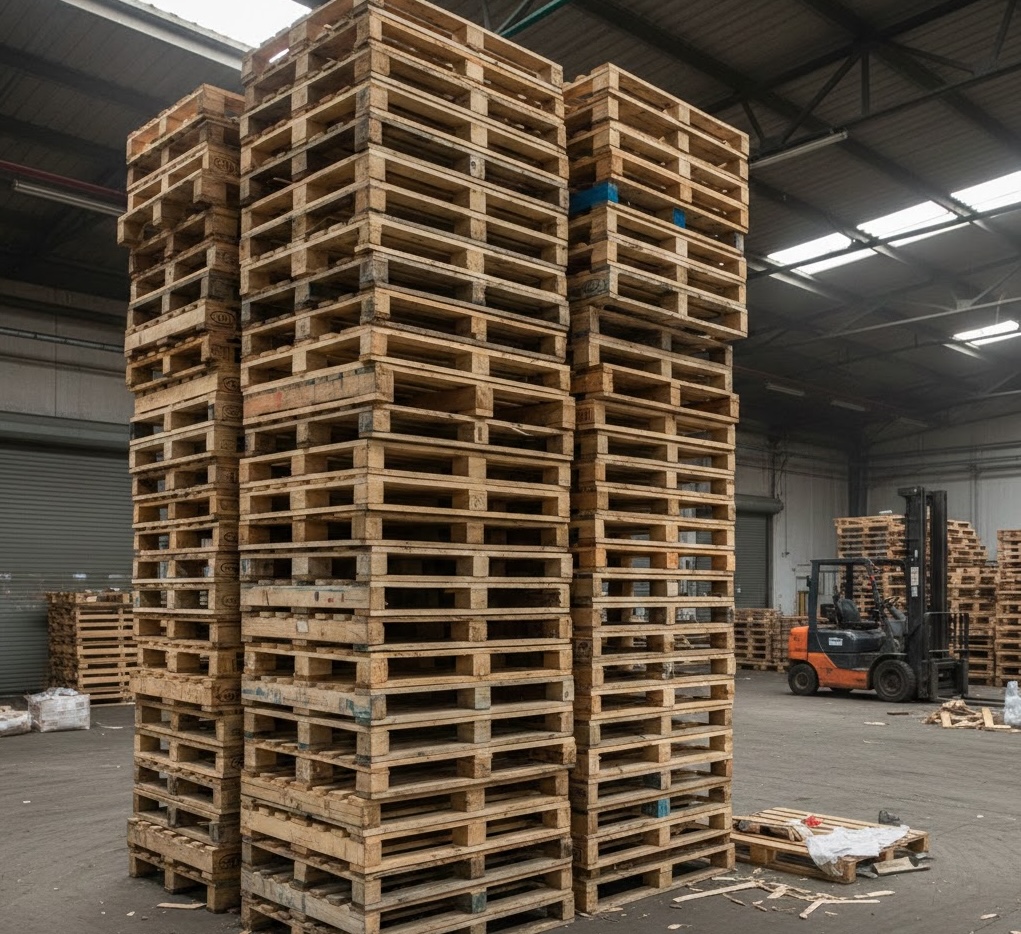
Empty Pallet Stacking
Maximum Stack Height
Limit empty pallet stacks to 15 pallets or 10 feet, whichever is lower, unless your facility has specific engineering approval for taller stacks. In outdoor environments or areas with foot traffic, reduce this to 10 pallets or 6 feet.
Surface Requirements
Stack pallets only on level, stable surfaces such as concrete or asphalt. Avoid stacking on uneven ground, soft soil, or sloped surfaces. Place the bottom pallet on blocks or dunnage to prevent moisture absorption and allow air circulation.
Stack Alignment
Ensure each pallet in the stack is aligned squarely with the ones below. Offset or misaligned pallets create instability. If a stack begins to lean more than 2 degrees from vertical, disassemble it and restack immediately.
Clearance Requirements
Maintain a minimum of 3 feet clearance below sprinkler heads and 18 inches from electrical panels. Keep at least 4 feet of clear aisle space on all accessible sides for forklift operation and emergency egress.
Loaded Pallet Stacking
Column Stacking
Each loaded pallet is stacked directly on top of the one below with loads aligned vertically. This is the strongest stacking method as the weight transfers straight down through the pallet structure. Recommended for uniform, stable loads such as cases and boxes.
Interlock Stacking
Each layer of product is rotated 90 degrees relative to the layer below, creating an interlocking pattern. This provides greater stack stability but may reduce accessibility to individual units. Commonly used for bags, sacks, and irregular-shaped products.
Maximum Loaded Stack Heights
Never exceed the bottom pallet's static load rating. A general guideline is 3 high for heavy loads (over 1,500 lbs per pallet) and 4 high for lighter loads (under 1,000 lbs per pallet). Always check that the bottom pallet's condition supports the total stack weight.
Securing Methods
Use stretch wrap, strapping, or corner boards to secure loads on pallets before stacking. Unstable or improperly secured loads are a leading cause of warehouse accidents. Stretch wrap should extend below the top deck boards to grip the pallet itself.
Fire Safety for Pallet Storage
Sprinkler Protection
Pallet storage areas must have adequate sprinkler protection per NFPA 13. Idle pallet storage is classified as high-hazard Group A commodity. In-rack sprinklers may be required for racked pallet storage above certain heights.
Separation Distance
Maintain at least 8 feet of separation between pallet storage areas and building walls, exits, or other stored commodities. Larger separation may be required based on total stored quantity and local fire code.
Storage Area Limits
Individual pallet stacks should not exceed 400 square feet in floor area. Groups of stacks should be separated by minimum 8-foot aisles. Maximum total idle pallet storage varies by facility but typically does not exceed 2,500 square feet per fire zone.
Outdoor Storage
Outdoor pallet storage should be at least 20 feet from buildings and property lines. Some jurisdictions require 50 feet or more. Limit outdoor stack heights and consider wind loading. Local fire departments may require notification of outdoor pallet storage locations.
Pallet Weight Guide
Pallet weight affects shipping costs, load calculations, and handling equipment requirements. Understanding the factors that influence pallet weight helps you make informed purchasing decisions.
Factors That Affect Pallet Weight
Wood Species
Hardwood pallets (oak, maple) weigh significantly more than softwood pallets (pine, spruce). A hardwood GMA pallet can weigh 45-48 lbs compared to 33-37 lbs for softwood. Hardwood is denser and generally stronger, but the weight difference affects shipping costs.
Moisture Content
Green (freshly cut) lumber can contain 30-50% moisture, making pallets much heavier than those made from kiln-dried or air-dried lumber. A green pallet can weigh 20-30% more than a dry one. Heat-treated pallets (ISPM-15) have reduced moisture content.
Construction Type
Block pallets use more wood than stringer pallets of the same dimensions, making them 10-20% heavier. A block-style GMA pallet typically weighs 45-55 lbs, while a stringer-style weighs 33-45 lbs. The additional weight provides greater structural strength.
Board Thickness and Count
Pallets with thicker deck boards or more boards weigh more. Full-deck (close-boarded) pallets can weigh 30-50% more than standard spacing configurations. Heavy-duty pallets designed for higher load capacities use thicker lumber throughout.
Weight by Pallet Size
| Pallet Size | Softwood (lbs) | Hardwood (lbs) |
|---|---|---|
| 48" x 40" (GMA) | 33-37 | 45-48 |
| 42" x 42" | 35-40 | 42-50 |
| 48" x 48" | 40-48 | 50-60 |
| 48" x 45" | 35-42 | 45-55 |
| 36" x 36" | 25-30 | 32-38 |
| 48" x 20" | 18-22 | 24-28 |
| 800 x 1200 mm (EUR) | 50-55 | 55-60 |
| 40" x 40" | 30-35 | 38-44 |
| 48" x 36" | 30-36 | 38-45 |
* Weights are approximate for stringer-style pallets at standard moisture content (below 19%). Block pallets and green lumber will weigh more. Actual weights vary by manufacturer and wood source.
Why Pallet Weight Matters
Shipping Costs
Heavier pallets increase freight charges. Switching from hardwood to softwood on 1,000 pallets per month can save $2,000-$4,000 annually in shipping alone.
Worker Safety
OSHA guidelines consider manual pallet handling ergonomics. Lighter pallets reduce the risk of musculoskeletal injuries during manual stacking and sorting.
Vehicle Payload
Pallet weight reduces available payload capacity. On a standard 53-foot trailer with 44,000 lbs capacity, lighter pallets allow more product per load.
Equipment Requirements
Heavier pallets require forklifts with higher lift capacity. Ensure your material handling equipment is rated for the total weight of loaded pallets.
Need a Custom Size?
We offer custom pallet manufacturing for unique applications. Whether you need oversized pallets for industrial equipment, miniature pallets for retail displays, or specific configurations for automated systems, we can build exactly what you need.
Custom Dimensions
Any size from 12" x 12" up to 120" x 120"
Special Materials
Heat-treated, kiln-dried, or specific wood species
Design Services
Our engineers help optimize your pallet design